Bench press: technique and injury risk
The bench press is the most popular exercise in the gym and at the same time one of the main sources of shoulder pain among amateur strength trainees. Most problems are related not to the exercise itself but to technique, excessive weight and a lack of spotting. Our editorial team explains how a safe bench press is structured, which injuries occur most often and how to avoid them.
Which structures work and are at risk in the bench press
The main movers in the bench press are the pectoralis major, the front head of the deltoid and the triceps. Stabilization is provided by the rotator cuff muscles, the muscles that fix the shoulder blades, and also the legs and back extensors, which create a stable support on the bench. How smoothly this system works determines both the result and safety.
The shoulder joint is the most mobile in the human body, and that is exactly why it is the least stable. The head of the humerus lies in a shallow joint socket and is held mainly by muscles and ligaments. In pressing with a heavy weight, especially at the bottom of the movement, the front capsule of the joint and the tendons receive a significant load.
Another vulnerable link is the acromioclavicular joint, where the collarbone connects to the shoulder blade. Repeated heavy presses transmit compressive loads to it, which in some athletes leads to specific changes in the bone tissue.
Finally, the pectoral muscle itself and its tendon at the point of attachment to the humerus undergo maximal stretching under load at the bottom position. This is exactly where one of the most serious injuries of strength sports arises — a rupture of the pectoralis major.
Common injuries: shoulder, chest, collarbone
A review by Kolber and colleagues (2010) on shoulder injuries associated with strength training names among the most frequent problems anterior instability, subacromial impingement syndrome, rotator cuff damage and osteolysis of the distal end of the collarbone. Many of them the authors associate with excessive range of motion, a wide grip and heavy weights.
Osteolysis of the distal clavicle was first described in detail by Cahill (1982) in athletes who did strength training. It is a condition in which the end of the collarbone gradually breaks down due to repeated micro-trauma. A person feels an aching pain in the upper part of the shoulder that intensifies during presses and dips.
A rupture of the pectoralis major is a rare but serious injury. A meta-analysis by Bak, Cameron and Henderson (2000), covering 112 cases, showed that most ruptures occurred during the bench press, mostly in men, and that surgical treatment gave better results than conservative treatment. The typical mechanism is the eccentric phase with a heavy weight, when the muscle is maximally stretched.
A narrative review by Bengtsson, Berglund and Aasa (2018) on injuries in powerlifting confirms that the shoulder is one of the most frequently affected areas specifically in connection with the bench press. At the same time, the overall injury rate in strength sports is low, and most problems develop gradually, as overuse rather than a sudden catastrophe.
| Injury | Typical signs | Risk factors |
|---|---|---|
| Subacromial pain, rotator cuff damage | Pain when raising the arm, especially above shoulder level | Wide grip, flared elbows, «floating» shoulder blades |
| Osteolysis of the collarbone | Aching pain in the upper part of the shoulder | Frequent heavy presses, dips |
| Rupture of the pectoral muscle | Sudden pain, a click, a bruise, deformation | Maximal weights, fast lowering, fatigue |
| Pain in the elbows and wrists | Pain when extending the arms | Excessive volume, backward extension of the wrist |

Technique: grip, shoulder blades, path
Grip width is the first parameter worth adjusting. A very wide grip increases horizontal abduction of the shoulder and the load on the front capsule as well as on the acromioclavicular joint. Reviews on exercise modifications for injured athletes, in particular the work of Fees and colleagues (1998), recommend for sensitive shoulders a grip no wider than roughly one and a half shoulder widths.
The position of the shoulder blades determines the stability of the whole structure. Before lifting the barbell off the rack, the shoulder blades are drawn together and down, creating a stable «platform» on the bench. A moderate arch in the thoracic spine, with the pelvis remaining on the bench, reduces the range of motion and offloads the front of the shoulder.
The elbows should not be flared at a right angle to the torso — this is the position in which the shoulder is most vulnerable. For most people a comfortable angle between the upper arm and the torso at the bottom is roughly 45–70 degrees. The barbell is lowered to the lower chest, not to the neck or upper chest.
Lowering the barbell should be controlled. A «bounce» off the chest from a fast drop of the barbell is a common way to lift more, but it is exactly in this phase that the risk to the pectoral muscle and the shoulder joint is highest. A short controlled pause on the chest is both safer and better for technique.
The legs are an underrated element of the press. The feet stand firmly on the floor, creating support for the torso. Raising the legs onto the bench or holding them in the air means depriving yourself of stability and transferring more load to the shoulder girdle.
Spotting and safe work with weight
The bench press is one of the few exercises in the gym where a mistake can be fatal. A barbell you cannot push up ends up on the chest or neck of a person lying down. There are known cases of death by asphyxiation when an athlete trained alone. So the spotting rules here are not a formality.
- A spotteris mandatory when working with weights close to your maximum.
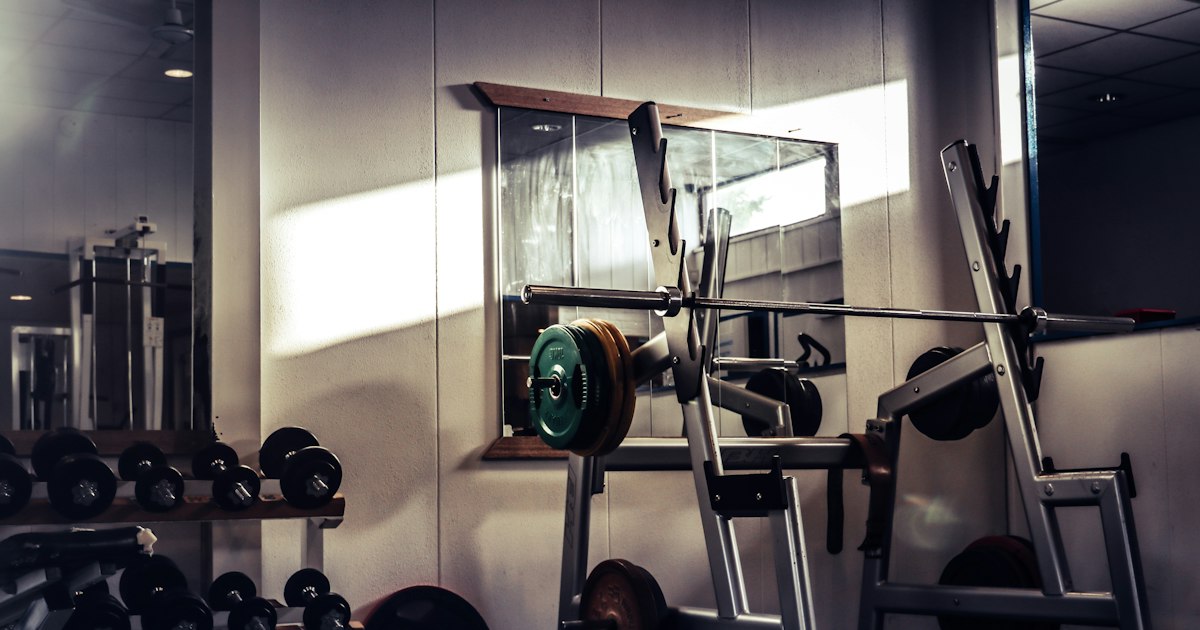
- Safety pinsin a power rack, set slightly below chest level, allow you to train safely alone.
- An open grip(without wrapping the thumb around the bar) sharply increases the risk of the barbell slipping — it should be avoided.
- Collars on the barare not used when training with safety pins, so that in an emergency you can dump the plates by tilting the bar.
- Dumbbellsare safer than a barbell for working to failure alone.
Maximum attempts are not needed for most amateurs. Strength grows even when working in the range of 3–8 reps with a reserve, and the injury risk in this case is lower. If you want to check your progress, you can estimate a calculated maximum from the number of reps with a submaximal weight.
The warm-up before pressing should include not only general warming but also several sets with a gradual increase in weight, as well as rotator cuff exercises with a band. A cold shoulder under a heavy weight is a common injury scenario.
The volume of pressing movements in the weekly plan also matters. If a program has many presses — flat, overhead, incline, dips — and few pulls, an imbalance of the shoulder-girdle muscles develops. A ratio of pressing to pulling sets of at least one to one is a sensible preventive measure.
Modifications for pain and prevention
If the press causes discomfort in the shoulder, you do not always have to give up the exercise. Narrowing the grip, reducing the range of motion, replacing the barbell with dumbbells with a neutral grip (palms facing each other) or pressing on a slightly inclined bench often helps. These changes reduce the load on the vulnerable structures.
A press with a limited range, for example with a board on the chest or with pins in a power rack, lets you keep training while avoiding the riskiest bottom position. This approach is often used during recovery from minor shoulder problems.
Prevention lies in a balanced program: regular pulls in the horizontal plane, exercises for the rear delts and rotator cuff, gradual progression and sufficient recovery. Pain that persists for more than a few days, worsens or is accompanied by weakness is a reason to see an orthopedist or sports doctor.
Sudden pain in the chest or armpit during a press, a feeling of a «click», the appearance of a bruise and a change in the contour of the pectoral muscle are signs of a possible rupture. In that case immediate consultation with a doctor is needed: for the best outcome, surgical treatment of a rupture is preferably performed as early as possible.
Editorial conclusions
The bench press is an effective exercise for the upper body, but the shoulder joint, collarbone and pectoral muscle are indeed vulnerable in it. Most problems are related to technique, excessive weight and program imbalance.
A moderate grip width, retracted shoulder blades, elbows at an angle to the torso, controlled lowering and a stable base with the legs are the foundation of a safe press.
Spotting or safety pins when working with a heavy barbell are mandatory: this is a matter not only of injury but of life.
Our editorial team also recommends reading our materials on back safety in the deadlift, on common mistakes in squatting and on cooling down and stretching after a workout.
References
- Kolber MJ, Beekhuizen KS, Cheng MS, Hellman MA. Shoulder injuries attributed to resistance training: a brief review. J Strength Cond Res. 2010;24(6):1696–1704.
- Fees M, Decker T, Snyder-Mackler L, Axe MJ. Upper extremity weight-training modifications for the injured athlete: a clinical perspective. Am J Sports Med. 1998;26(5):732–742.
- Bak K, Cameron EA, Henderson IJ. Rupture of the pectoralis major: a meta-analysis of 112 cases. Knee Surg Sports Traumatol Arthrosc. 2000;8(2):113–119.
- Cahill BR. Osteolysis of the distal part of the clavicle in male athletes. J Bone Joint Surg Am. 1982;64(7):1053–1058.
- Bengtsson V, Berglund L, Aasa U. Narrative review of injuries in powerlifting with special reference to their association to the squat, bench press and deadlift. BMJ Open Sport Exerc Med. 2018;4(1):e000382.
- Aasa U, Svartholm I, Andersson F, Berglund L. Injuries among weightlifters and powerlifters: a systematic review. Br J Sports Med. 2017;51(4):211–219.
Andriy Melnyk
A strength-sports coach and author of programs for beginner and intermediate levels. Writes about training planning.