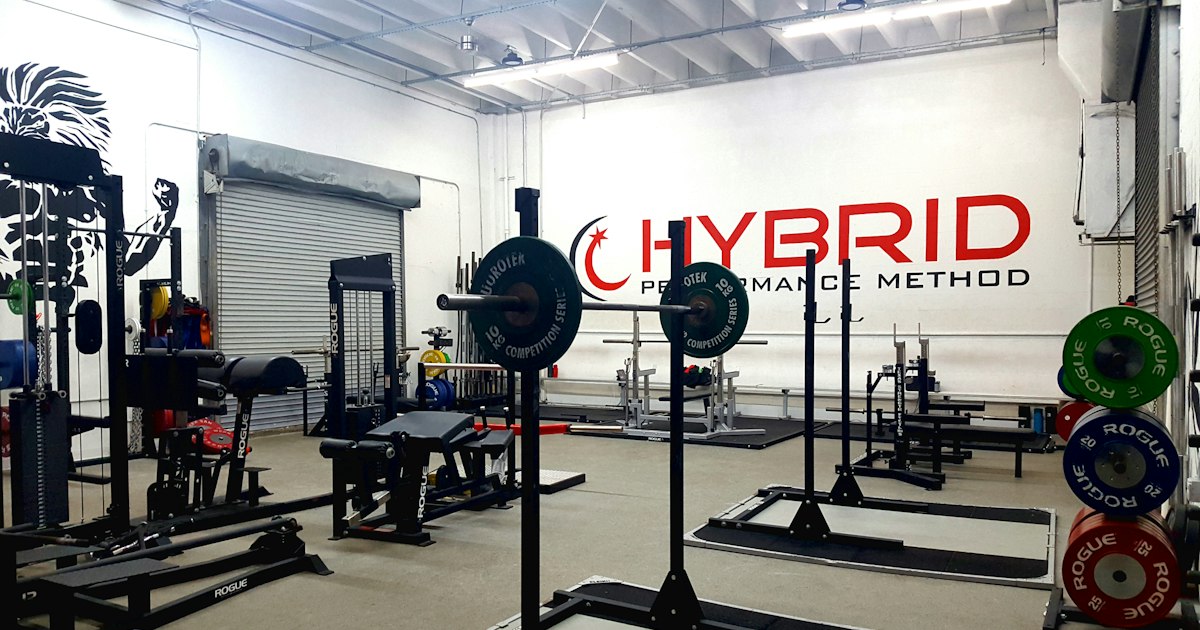
Three-day split: a sample program

Three workouts a week is the most common schedule for people who work, study and yet want noticeable progress in the gym. A three-day split lets you focus on individual muscle groups and give them time to recover. Our editorial team explains how to build such a program, provides a working example and describes when a split is justified and when it is better to choose a different format.
What a split is and how it differs from full body
A split (from the English split — «to divide») is a way of organizing workouts in which muscle groups are distributed across different days. Instead of working the whole body every time, a person trains, for example, chest, shoulders and triceps on Monday, back and biceps on Wednesday, and legs on Friday. Each group receives a heavy load once a week and has several days to recover.
The opposite approach is full body, when every session includes exercises for all the main muscle groups. With three workouts a week, full body gives each muscle a frequency of three times a week, but with less volume per session. A split, on the contrary, concentrates volume: more sets per group in a single day, but less often.
There are several classic variants of the three-day split. The best known is «push–pull–legs» (push–pull–legs), which combines muscles that work in similar movements. Another variant is «upper–lower–upper» alternating by weeks. There are also «bodybuilding» schemes such as «chest+biceps / back+triceps / legs+shoulders».
None of these schemes is «correct» in itself. The choice depends on your training level, goals, time available for training and how you tolerate the load. Next we will look at what science says about training frequency and why a three-day split is better suited to people with some experience.
Frequency and volume: what the research says
A meta-analysis by Schoenfeld, Ogborn and Krieger (2016) compared training each muscle group once a week versus twice a week. With equal or similar volume, a frequency of twice a week produced slightly better muscle-mass gains. Later work clarified this: the main role is played by the total weekly volume, and frequency is mostly a way to distribute that volume conveniently.
Another meta-analysis by the same group (2017) showed a dose-dependent relationship between the number of working sets per muscle group per week and hypertrophy: more sets means, on average, more gain, at least up to a certain point. For strength indicators, a review by Grgic and colleagues (2018) likewise found that volume, not frequency as such, is decisive.
What does this mean for a three-day split? If each group is trained only once a week, you need to perform enough volume in a single session. And too many sets in a row reduce the quality of the last of them due to fatigue. That is why a classic split works better when a session has 2–3 exercises per group and 6–10 quality working sets in total.
The ACSM position stand on progression models in strength training (2009) recommends that beginners train the whole body 2–3 times a week, while experienced athletes move to split programs. The logic is simple: a novice progresses from a small volume and frequent technique practice, whereas an experienced trainee needs more sets per group to keep adaptation going.

A sample «push–pull–legs» program
Below is an example that our editorial team considers balanced for a person with six to twelve months of regular training. The number of sets given is working sets, excluding warm-up sets. Rest between sets is 2–3 minutes in the compound exercises and 1–2 minutes in the isolation exercises. The working weight is chosen so that you finish the set with 1–3 reps in reserve before failure.
| Day | Exercise | Sets × reps |
|---|---|---|
| Day 1: Push | Barbell bench press | 4 × 6–8 |
| Incline dumbbell press | 3 × 8–10 | |
| Seated dumbbell press | 3 × 8–10 | |
| Dumbbell lateral raises | 3 × 12–15 | |
| Cable triceps pushdowns | 3 × 10–12 | |
| Day 2: Pull | Pull-ups or lat pulldowns | 4 × 6–10 |
| Bent-over barbell row | 3 × 8–10 | |
| Seated cable row | 3 × 10–12 | |
| Bent-over raises (rear delts) | 3 × 12–15 | |
| Barbell biceps curls | 3 × 8–12 | |
| Day 3: Legs | Barbell squats | 4 × 5–8 |
| Romanian deadlift | 3 × 8–10 | |
| Leg press or lunges | 3 × 10–12 | |
| Leg curls in a machine | 3 × 10–12 | |
| Calf raises | 3 × 12–15 |
It is advisable to leave at least one rest day between workouts: the classic schedule is Monday, Wednesday, Friday. If your schedule does not allow it, two workouts in a row are acceptable, for example «pull» and «leg», since they load different groups. However, keep in mind that the Romanian deadlift and the bent-over row heavily involve the back extensors.
Each session under this scheme takes about 60–75 minutes including the warm-up. If you have less time, you can cut one isolation exercise each, but it is better to keep the compound movements at the start of the workout, since it is they that provide the greatest stimulus for strength and mass.
The abs and core muscles can be trained at the end of any of the days with 2–3 exercises. For the glutes and hamstrings, Day 3 already contains enough volume, so a separate «glute day» is not needed in this scheme.
Load progression and recovery
The main driver of progress in any program is a gradual increase in load. In a three-day split it is convenient to use «double progression»: first you increase the number of reps within the range, and once you reach the upper limit in all sets, you add weight (usually 2.5–5 kg in the compound exercises) and start again from the lower limit.
Since each group is trained only once a week, progress in weights may be slower than with full body, especially in the first year. Do not worry about this: even if strength does not increase every week, hypertrophy can continue as long as the total volume is sufficient.
Every 6–10 weeks it is useful to plan a deload week, when volume is reduced by about half and intensity is kept moderate. This helps relieve accumulated fatigue in the joints and nervous system. Signs that a deload is needed sooner: a drop in working weights over several workouts in a row, worsening sleep, constant joint stiffness.
Recovery is determined not only by the program but also by life outside the gym: 7–9 hours of sleep, sufficient protein intake (in studies of people who train, a range of roughly 1.6–2.2 g per kilogram of body weight per day most often appears) and the overall calorie content of the diet. Without these conditions, even a perfect split will not deliver the expected result.
Common mistakes in a three-day split
The most common mistake is transferring a «bodybuilding» program built for five or six days into three days by simply adding exercises. As a result, each workout stretches to two hours, the last exercises are performed under severe fatigue, and the quality of work drops. It is better to choose fewer exercises and perform them with focus.
- Too little volume per group:two or three exercises of two sets once a week rarely provide enough stimulus.
- Skipping leg days:an uneven program eventually leads to imbalances in strength and proportions.
- Lack of progression:the same weights and reps for months is the most frequent cause of a «plateau».
- A split for a novice:in the first months, more frequent practice of the compound movements in full body is usually more effective.
- Ignoring the warm-up:before the day’s compound exercise you need a few sets with a gradual increase in weight.
Another mistake is skipping one workout of the week without adjusting. If in a split you skip «leg», the leg muscles receive zero load for the week. In full body, missing a single session is less critical. That is why, for people with an unstable schedule, our editorial team advises either rescheduling the missed day or switching to full body.
Finally, it is worth remembering that the choice of split is a matter of comfort and adherence. Meta-analyses show that the difference between well-designed programs with equal volume is small, and what matters most is regularity and progression over months and years.
Editorial conclusions
A three-day split is a working format for people with basic experience who want to increase the volume for each muscle group and train three times a week. The «push–pull–legs» scheme is simple, logical and gives each group a week to recover.
Research indicates that what matters most is sufficient weekly volume and progression, while frequency is a tool for distributing it. So a split requires more quality sets per session than full body and does not forgive systematic skipping.
In the first months, beginners are usually better suited by full body, and switching to a split is justified when progress on a general program slows down.
We also recommend our articles on full body for beginners, on squat technique and common mistakes, and on back safety in the deadlift.
References
- Schoenfeld BJ, Ogborn D, Krieger JW. Effects of resistance training frequency on measures of muscle hypertrophy: a systematic review and meta-analysis. Sports Med. 2016;46(11):1689–1697.
- Schoenfeld BJ, Ogborn D, Krieger JW. Dose-response relationship between weekly resistance training volume and increases in muscle mass: a systematic review and meta-analysis. J Sports Sci. 2017;35(11):1073–1082.
- Grgic J, Schoenfeld BJ, Davies TB, et al. Effect of resistance training frequency on gains in muscular strength: a systematic review and meta-analysis. Sports Med. 2018;48(5):1207–1220.
- American College of Sports Medicine. American College of Sports Medicine position stand. Progression models in resistance training for healthy adults. Med Sci Sports Exerc. 2009;41(3):687–708.
- Morton RW, Murphy KT, McKellar SR, et al. A systematic review, meta-analysis and meta-regression of the effect of protein supplementation on resistance training-induced gains in muscle mass and strength in healthy adults. Br J Sports Med. 2018;52(6):376–384.
- Schoenfeld BJ, Grgic J, Ogborn D, Krieger JW. Strength and hypertrophy adaptations between low- vs. high-load resistance training: a systematic review and meta-analysis. J Strength Cond Res. 2017;31(12):3508–3523.
Andriy Melnyk
A strength-sports coach and author of programs for beginner and intermediate levels. Writes about training planning.