Deadlift technique: back safety
The deadlift has a reputation as an exercise that «breaks backs». Yet it is precisely the deadlift that teaches you to safely lift heavy things from the floor — a skill needed in everyday life. Our editorial team looked into what loads the spine receives, what research says about lower-back rounding, and how to build a technique that minimizes the risks.
How the deadlift loads the spine
In the deadlift the barbell is lifted from the floor to full extension of the body through extension of the hip and knee joints. The spine in this exercise should work as a rigid rod that transmits force from the legs to the arms. The back extensors, core muscles and lats hold its position rather than move it.
The load on the lumbar region is very significant. The classic work of Cholewicki, McGill and Norman (1991), which analyzed the deadlift of competitive powerlifters, estimated compression forces in the lumbar region at a level several times body weight. The spine is able to withstand such loads, but only provided that they are built up gradually and distributed evenly.
It is important to understand the difference between compression and shear. When the spine is neutral, the main load is axial compression, to which the discs and vertebrae are best adapted. When the back bends heavily under load, the share of shear forces and the load on the posterior structures of the disc and the ligaments increase.
Bone and connective tissue adapt to strength training: the density of the vertebrae increases and the ligaments become stronger. So a deadlift that is dangerous for an unprepared person with a heavy weight can be entirely safe for an athlete who has increased the load gradually over years.
Rounding of the back: a real threat or an exaggeration
The traditional coaching dogma goes: «Never round your back». The biomechanist Stuart McGill, in his works on lumbar spine disorders, argues that repeated flexion of the spine under load can contribute to disc damage. This position underlies the classic neutral-spine technique.
At the same time, a systematic review with meta-analysis by Saraceni and colleagues (2020) found no convincing link between lumbar flexion during lifting and back pain. The authors stress that the data are heterogeneous and relate mainly to everyday and occupational lifting rather than maximal weights in the gym.
How to reconcile these positions? Our editorial team considers the following conclusion reasonable: slight rounding of the thoracic region at submaximal weights in experienced athletes is not necessarily harmful, and the human body is generally resilient to various positions. However, sharp, uncontrolled flexion of the lower back under a maximal weight, especially in a state of fatigue, is a scenario worth avoiding.
A practical rule: the spine should keep the position you took at the start throughout the entire lift. If the back rounds during the movement — «stretches out» under the weight — it is a sign that the weight is too heavy or the core muscles have tired. It is precisely the change of position under load, rather than the initial shape of the back, that most often becomes the problem.
The starting position and bar path
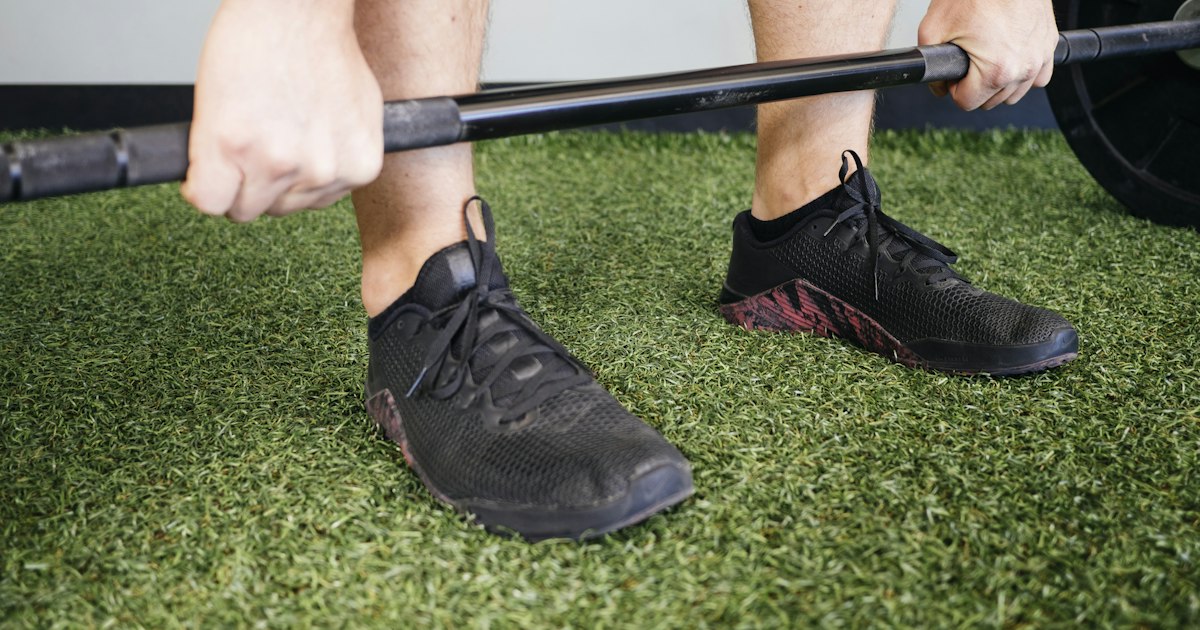
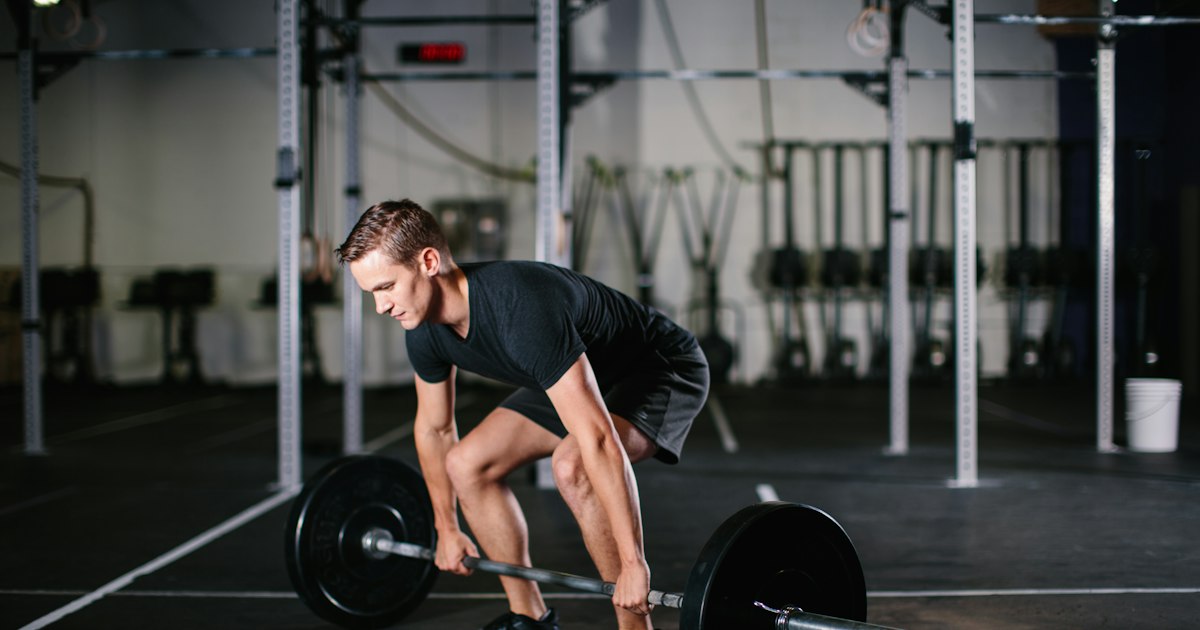
A safe deadlift begins before the barbell leaves the floor. The bar is positioned over the middle of the foot, roughly a few centimeters from the shins. The feet stand about hip-width apart, the grip a little wider than the legs. The person bends toward the bar, flexing the knees, until the shins touch the bar.
- Stand so that the bar is over the middle of the foot.
- Grip the bar without shifting it.
- Lower the pelvis until the shins touch the bar; the shoulders are slightly ahead of the barbell.
- Take a breath, brace the core and «take out the slack» — tension the bar without a jerk.
- Lift the barbell by pushing the floor with your legs; the bar slides along the legs.
- Finish the movement by extending the hips, without hyperextending the lower back.
The key detail is the bar path. It should move as vertically and as close to the body as possible. Every centimeter of distance between the barbell and the shins increases the lever arm and the torque on the lower back. So clothing that lets the bar slide, and contact of the bar with the thighs, are not trifles but an element of safety.
A jerk at the start is one of the most dangerous mistakes. When a person yanks the barbell sharply, the spine does not have time to stabilize and for an instant receives a peak load in an unfavorable position. «Taking out the slack» — tensioning the bar so that it almost lifts — helps engage the muscles before the main effort.
Lowering the barbell should also be controlled, but not too slow. First the pelvis moves back, the barbell slides down the thighs, and only after passing the knees do the legs bend. You should not «drop» the barbell from a height, but slow eccentric lowering with a maximal weight also increases fatigue without obvious benefit.
Conventional, sumo and trap bar: which to choose
There are several main variants of the deadlift, and they load the back differently. An electromyographic analysis by Escamilla and colleagues (2002) compared the conventional and sumo deadlift: in sumo the torso is more vertical and the quadriceps work more, whereas in the conventional lift there is a greater lean and more load on the back extensors.
| Variant | Torso position | Load on the lower back | Who it suits |
|---|---|---|---|
| Conventional | Greater forward lean | Higher | People with long arms, for developing the posterior chain |
| Sumo | More vertical | Lower | People with good hip mobility |
| Trap bar (hex bar) | Vertical, weight at the sides | Lower | Beginners, people with a sensitive back |
| Romanian deadlift | Lean, minimal knee bend | Moderate | For developing the hamstrings |
The trap bar deserves special attention. A study by Swinton and colleagues (2011) showed that with a hexagonal bar the torque on the lumbar region is lower than with a straight bar, because the weight is positioned at the sides of the body rather than in front. For most amateurs who do not compete in powerlifting, this is an excellent choice.
It is also useful to use a deadlift from a raised position (from pins or blocks) if mobility does not allow you to start the movement from the floor with a neutral back. The reduced range lets you drill technique, and over time, as mobility improves, the height can be lowered.
The choice between conventional and sumo is often determined by anatomy. For people with a long torso and short arms the conventional position is harder, while sumo allows the torso to stay more vertical. At the same time, sumo requires good hip mobility and can load the hip adductors. The best option is the one in which you steadily hold the position of your back from the first to the last rep.
Risk factors and injury prevention
A systematic review by Aasa and colleagues (2017) on injuries in weightlifting and powerlifting showed that the lower back is one of the most frequently injured areas, but the overall injury rate in these sports is relatively low per thousand training hours — lower than in many team sports.
- A sharp increase in weightwithout gradual tissue adaptation.
- Fatigue:deadlifting at the end of a long workout or overly long sets.
- An inadequate warm-upand skipping warm-up sets.
- Attempting a maximumwithout experience and without need.
- Ignoring painand training «through pain».
For most people there is no need to test a maximum in the deadlift regularly. Working in the range of 3–8 reps with 1–3 reps in reserve provides an excellent stimulus for strength and mass, while technique stays stable. It is sensible to place the deadlift at the start of a workout, when the nervous system is fresh.
A lifting belt can raise intra-abdominal pressure and help with stabilization under heavy weight, but it does not replace technique and your own core strength. People with hypertension, hernias or other spinal diseases must discuss the deadlift and breathing technique with a doctor.
Editorial conclusions
The deadlift, with correct technique and gradual progression, is a relatively safe and very effective exercise. The spine adapts to loads just as muscles do.
The main safety principles are a stable spine position throughout the entire lift, the bar close to the body, a smooth start without a jerk, and avoiding maximal weights in a state of fatigue.
For people with a sensitive back or without competitive goals, the trap bar and the deadlift from a raised position can be a sensible alternative to the conventional lift.
We also recommend our materials on common mistakes in squatting, on the bench press and injury risk, and on the three-day split.
References
- Cholewicki J, McGill SM, Norman RW. Lumbar spine loads during the lifting of extremely heavy weights. Med Sci Sports Exerc. 1991;23(10):1179–1186.
- McGill S. Low Back Disorders: Evidence-Based Prevention and Rehabilitation. 3rd ed. Human Kinetics; 2016.
- Saraceni N, Kent P, Ng L, et al. To flex or not to flex? Is there a relationship between lumbar spine flexion during lifting and back pain? A systematic review with meta-analysis. J Orthop Sports Phys Ther. 2020;50(3):121–130.
- Escamilla RF, Francisco AC, Kayes AV, et al. An electromyographic analysis of sumo and conventional style deadlifts. Med Sci Sports Exerc. 2002;34(4):682–688.
- Swinton PA, Stewart A, Agouris I, et al. A biomechanical analysis of straight and hexagonal barbell deadlifts using submaximal loads. J Strength Cond Res. 2011;25(7):2000–2009.
- Aasa U, Svartholm I, Andersson F, Berglund L. Injuries among weightlifters and powerlifters: a systematic review. Br J Sports Med. 2017;51(4):211–219.
Andriy Melnyk
A strength-sports coach and author of programs for beginner and intermediate levels. Writes about training planning.